

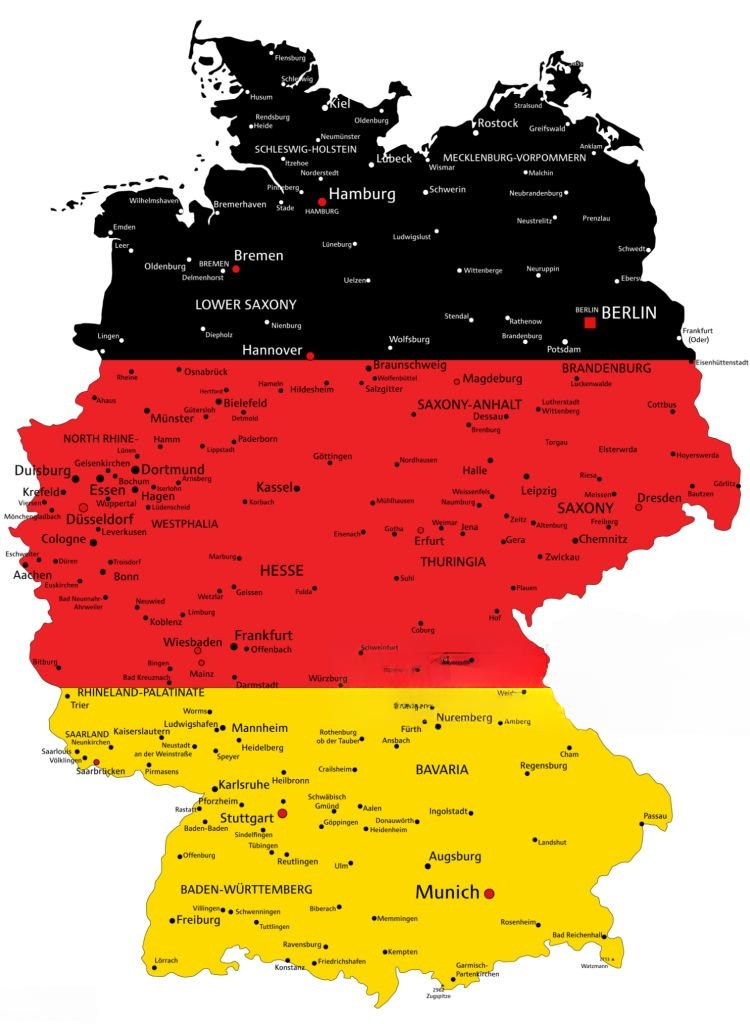
Germany, as Turkey's largest export partner, forms one of the cornerstones of the commercial relationship between the two countries. There are many factors that Turkish exporters need to take into account in their shipments to Germany. One of the most important of these is the region's postal system and addressing structure. Germany's comprehensive and well-organized postal infrastructure ensures that commercial shipments arrive on time and safely, while also having a direct impact on exporters' costs and processes. Correct use of the postal code (PLZ) structure, delivery times and pricing play a decisive role in shaping the export strategies of Turkish businesses.
Germany Postal Codes
Postal codes in Germany (Postleitzahl, or PLZ for short) consist of five digits, and the first digit divides the country into ten large postal zones from 0 to 9. The table below shows the postal code ranges corresponding to selected federal states and the number of postal codes in each state.
| Postal Codes | Administrative Region | Number of Postal Codes |
|---|---|---|
| 68131 – 79879, 88212 – 89198 | Baden-Württemberg | 1,210 |
| 54290 – 57648, 66849 – 67829 | Rhineland-Palatinate | 654 |
| 80331 – 97909 | Bavaria | 2,078 |
| 66041 – 66839 | Saarland | 72 |
| 34117 – 37299, 60306 – 63699, 64283 – 65936 | Hesse | 570 |
| 01067 – 04889, 08056 – 09669 | Saxony | 436 |
| 06108 – 06928, 38820 – 39649 | Saxony-Anhalt | 222 |
| 03042 – 03253, 14461 – 17326 | Brandenburg | 228 |
| 10115 – 14532 | Berlin | 198 |
| 20038 – 21149, 22041 – 22769 | Hamburg | 102 |
For companies making regular shipments to Germany, you can visit our road transportation and air transportation pages to learn more about our services!
Germany Postal Zones and Population
The first digit of the postal code divides Germany into ten zones from 0 to 9. The table below shows the area covered by each zone, its population and its major cities.
| PLZ Zone | Area (km²) | Population | Region Covered | Major Cities |
|---|---|---|---|---|
| 0 | 37,187.8 | 6,819,607 | Saxony; the southern parts of Saxony-Anhalt and Brandenburg; the eastern part of Thuringia | Dresden, Leipzig, Halle, Chemnitz, Cottbus, Jena |
| 1 | 47,642.4 | 7,034,541 | Berlin; large parts of Brandenburg and Mecklenburg-Vorpommern; small parts of Lower Saxony and Saxony-Anhalt | Berlin, Potsdam, Frankfurt (Oder), Rostock, Schwerin |
| 2 | 44,207.4 | 8,691,409 | Hamburg; Schleswig-Holstein; the northern part of Lower Saxony; Bremen; a small part of Mecklenburg-Vorpommern | Hamburg, Lübeck, Kiel, Bremen, Bremerhaven, Oldenburg |
| 3 | 45,488.1 | 9,012,212 | The southern part of Lower Saxony; the eastern part of Westphalia; the northern parts of Hesse, Thuringia and Saxony-Anhalt | Hanover, Bielefeld, Kassel, Fulda, Gießen, Göttingen, Braunschweig, Magdeburg |
| 4 | 20,212.3 | 10,331,535 | The north-western part of North Rhine-Westphalia; the south-western part of Lower Saxony | Düsseldorf, Dortmund, Essen, Duisburg, Bochum, Wuppertal, Münster, Mönchengladbach, Gelsenkirchen, Oberhausen, Osnabrück |
| 5 | 28,834.5 | 9,233,815 | The south-western part of North Rhine-Westphalia; Rhineland-Palatinate; a small part of Hesse | Cologne, Bonn, Aachen, Mainz, Koblenz, Trier |
| 6 | 17,247.9 | 7,540,503 | The southern parts of Hesse; Rhineland-Palatinate; Saarland; small parts of Bavaria and Baden-Württemberg | Frankfurt am Main, Wiesbaden, Darmstadt, Saarbrücken, Heidelberg, Mannheim, Aschaffenburg |
| 7 | 27,864.2 | 8,715,898 | The greater part of Baden-Württemberg; a small part of Rhineland-Palatinate | Stuttgart, Karlsruhe, Tübingen, Freiburg, Konstanz, Baden-Baden |
| 8 | 36,427.2 | 7,675,001 | The southern part of Bavaria; the south-eastern part of Baden-Württemberg | Munich, Rosenheim, Augsburg, Ulm, Ingolstadt |
| 9 | — | — | The northern part of Bavaria (Franconia); most of Thuringia; a small part of Saxony | Nuremberg, Würzburg, Erfurt, Regensburg, Bayreuth |
The Most Populous Cities in Germany
Germany is a country known for its rich history and cultural diversity, and it is home to many populous and important cities. Berlin, the country's capital and most populous city, stands out with its historic buildings and modern lifestyle. Hamburg has the country's largest port and is one of its centers of trade. Munich, the capital of the state of Bavaria, is famous for cultural events such as Oktoberfest.
Cologne is known for its famous cathedral and its location on the banks of the Rhine, while Frankfurt am Main holds an important position as Germany's financial center. Essen stands out as one of the industrial centers of the Ruhr region. Stuttgart is known for its automotive industry and green spaces.
Dortmund is known especially for its football club, while Düsseldorf is famous for its fashion and art scene. The port city of Bremen attracts attention with its historic buildings. Hanover is another important city known for its trade fairs. Leipzig is known for its cultural and historical riches. Duisburg stands out as an important industrial city, while Nuremberg is notable for its history and tourist appeal. Dresden is a city famous for its baroque architecture and works of art.
- Berlin
- Hamburg
- Munich
- Cologne
- Frankfurt am Main
- Essen
- Stuttgart
- Dortmund
- Düsseldorf
- Bremen
- Hanover
- Leipzig
- Duisburg
- Nuremberg
- Dresden
You May Be Interested In: What Are Chinese Postal Codes?