EN

Economic Transportation, Premium Transportation, Charter Transportation, Project Transportation, Multimodal Transportation
Air transportation is the carriage of commercial cargo from the departure airport to the destination airport, either in the cargo holds of passenger aircraft or on dedicated freighters. A shipment moves through acceptance of the goods, export customs clearance, handover to the airline, the flight itself, arrival customs and final delivery. The process is documented with an air waybill (AWB), and the shipment is tracked through that number.
What separates air from other transport modes is speed. An intercontinental shipment is usually completed within 1-5 days, while the same route takes weeks by sea. The small number of handling steps reduces the risk of damage, and strict airport security provides additional protection for high-value cargo. On the other hand, the unit cost is higher than other modes and capacity is limited. For this reason air transport is chosen for time-sensitive, valuable, light or perishable goods. We compare the strengths and weaknesses of the mode in our article on the advantages and disadvantages of air cargo transportation.
As an IATA member, Tetalog manages the entire air transportation process: booking and securing space, documentation, export and import customs clearance, special cargo procedures and door-to-door delivery. You can follow every stage of your shipment through our tracking system and stay in direct contact with our operations team.
Air cargo transportation is offered at different service levels according to the urgency, volume and special requirements of the cargo. Tetalog identifies the most suitable model for each shipment and strikes the right balance between cost and transit time. The service options are listed below; see the relevant pages for details.
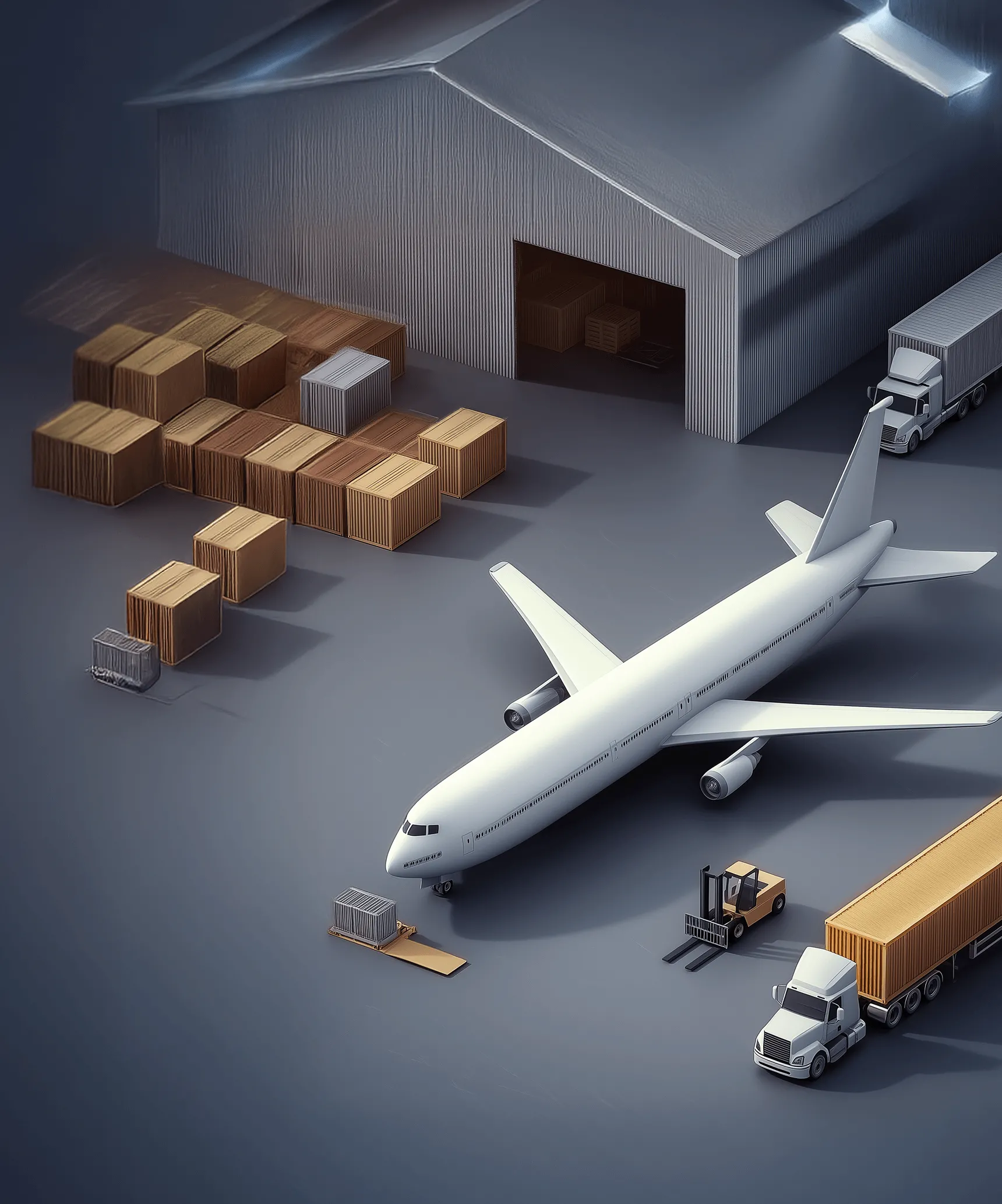
The choice of transport model rests on three criteria: the volume of the cargo, the urgency of delivery and any special handling requirements. For small and mid-sized consignments, consolidated air freight is the most economical solution; cargo from different customers is consolidated on the same aircraft, bringing the unit cost down. For large-volume or out-of-gauge shipments, or where scheduled services cannot meet the deadline, a charter flight is used and the aircraft capacity is dedicated to a single consignment.
Where dangerous goods, temperature-controlled products, live animals or high-value cargo are involved, the service is selected according to those requirements. For the full list of cargo types that can be carried by air and the operational details, see our air cargo transportation guide.

Air cargo charges are based on whichever is greater: the actual weight of the shipment or its volumetric weight. This figure is known as the chargeable weight. Under the IATA standard, volumetric weight is found by multiplying the length, width and height of the shipment in centimetres and dividing the result by 6,000. For example, a 40 kg package measuring 100 × 80 × 60 cm corresponds to a volumetric weight of 80 kg, and the charge is applied over 80 kg.
Fuel and security surcharges, terminal handling fees, customs clearance and any special cargo surcharges are added to the total. For the details of the calculation, see our articles on what freight means and how it is calculated and desi calculation. For a net rate specific to your shipment, simply complete the quotation form.
Air cargo transit time is the total period from the acceptance of the goods until they reach the destination. The main factors are the flight route and number of transfers, airport ground handling, the duration of customs procedures and seasonal capacity pressure. On routes with direct flights, delivery generally takes 1-3 days; on routes with transfers, 3-5 days.
At the booking stage, Tetalog evaluates the schedules of several airlines to plan the most suitable route and transit time. For time-critical consignments, AOG loading and time critical transport solutions are brought into play.
For the process to run without disruption, the document set must be prepared completely. The central document of the shipment is the air waybill (AWB), which evidences the contract of carriage. Alongside it, the commercial invoice, packing list and certificate of origin are requested as standard. An ATR movement certificate is required for shipments to European Union countries, and DGR (Dangerous Goods Regulations) forms are mandatory for dangerous goods consignments.
Inconsistencies between documents — in weight, number of packages or description of goods — are the most common cause of delays at customs. Tetalog checks the documentation before the shipment to eliminate that risk. You can find the function of each document in detail in our article on what an air waybill (AWB) is.





Tetalog optimizes your operational processes with integrated air cargo solutions. Our international network covering 195 countries offers maximum efficiency in time and cost management.
Within our European flight network, Germany air cargo, France air cargo, Italy air cargo, UK air cargo, Netherlands air cargo, Belgium air cargo, and Poland air cargo operations are planned according to the shipment’s delivery time and service requirements. In addition to America air cargo and America air freight shipments, route, transfer, and customs processes for Canada air cargo and Uzbekistan air cargo operations are also organized according to the characteristics of the cargo.
Planning is carried out according to IATA standards for special requirements such as hazardous materials, sensitive equipment, or temperature-controlled cargo. We ensure end-to-end logistics management with door-to-door delivery, traceability systems, and transportation models customized according to cargo density.
By combining speed, safety, and cost advantages in air freight transportation, we strengthen your supply chain.
In international air transportation we operate through an agency network covering 195 countries. For shipments departing Turkey, loading can be arranged from all cargo terminals, primarily Istanbul Airport and Sabiha Gökçen. Our region-based operational structure allows us to manage the process from a single point in markets where customs procedures and delivery conditions differ.
We provide services within Europe through road, sea, and multimodal transportation solutions. We ensure stable transportation across the continent with compliant, planned, and time-focused operations in full accordance with legal regulations. We conduct all processes transparently.
Europe Premium Service AreasWe offer logistics solutions tailored to regional conditions in Africa. We perform flexible planning according to different transportation infrastructures and customs processes, and we manage the entire process from start to finish with transshipment or direct deliveries.
Africa Premium Service AreasAsia we provide logistics services to all countries across Asia. In some regions, in addition to transportation processes, we also handle customs clearance, distribution, and field operations. We manage processes end-to-end with flexible solutions suitable for high trade volumes.
Asia Premium Service AreasContact our expert team for your air logistics needs.


Tetalog is an IATA member freight forwarder. This membership allows us to work directly with airlines and to issue air waybills, which is a decisive advantage in securing space during peak seasons. Working with more than one airline means we can offer route and rate alternatives without being tied to the capacity of a single carrier.
For dangerous goods, temperature-controlled products and high-value cargo, planning is carried out in line with IATA standards. Handling customs clearance in-house reduces delays caused by documentation. With additional services such as door-to-door delivery, warehousing and packaging, your shipment is managed from a single point.
Fast delivery, low risk of damage, high security and reduced stock costs are the main advantages. Thanks to the extensive global air network, regions without seaports can also be reached.
Consolidated air freight is an economical model in which cargo belonging to different customers is combined on the same aircraft. It suits small and mid-sized urgent consignments.
A charter flight is a model in which the aircraft capacity is dedicated to a single customer's cargo. It is used for large-volume, out-of-gauge, urgent shipments or those requiring special handling conditions.
Transit time varies according to origin and destination, flight route, number of transfers and customs procedures. It is generally 1-3 days on direct flights and 3-5 days on routes with transfers.
The air waybill (AWB), commercial invoice, packing list and certificate of origin are the standard documents. An ATR certificate is added for shipments to EU countries, and DGR forms for dangerous goods.
The rate is based on whichever is greater, the actual or the volumetric weight. Volumetric weight is found by dividing length × width × height (cm) by 6,000. Fuel, security and terminal surcharges are then added.