

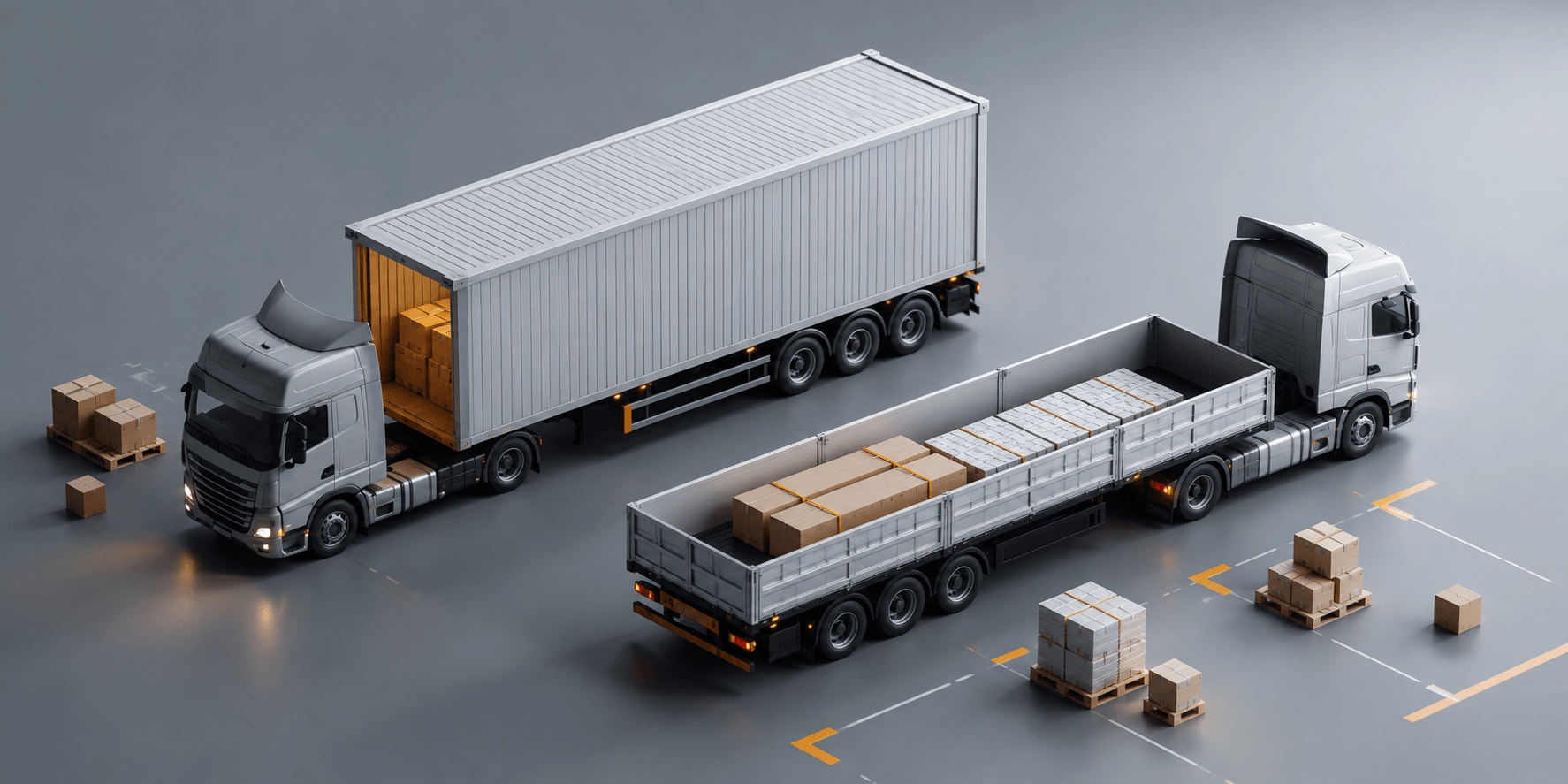
A trailer is a semi-trailer structure that is attached to the back of a tractor unit, carries cargo, and has no engine of its own. A semi-trailer is defined as a trailer in which part of its own weight and the weight of the cargo it carries is borne by the motorized vehicle. In everyday transport language, when people ask what a trailer is, most refer directly to the cargo unit attached to the tractor. In road freight transport, the trailer is prepared in different body and chassis configurations depending on the type of load. As needs change across areas such as dry cargo, heavy machinery, cold chain products, and container transport, the trailer structure changes accordingly.
What Is a Trailer Used For?
A trailer is used to transport cargo safely, efficiently, and in accordance with transport requirements from one point to another. Thanks to the semi-trailer structure, the tractor unit and the cargo unit can be separated from one another. This setup provides flexibility in operational planning — the tractor can take on another load while the trailer waits at the loading or unloading area. For shipments requiring an open platform, a flatbed or lowbed is preferred, while curtainsider or refrigerated structures come to the fore for loads that may be affected by weather conditions. The choice among trailer types is determined by the size, weight, protection needs, and loading method of the cargo.
What Are the Types of Trailers?
The range of trailer types referenced in the market is quite broad. The primary distinction is drawn between full trailers and semi-trailers. In field terminology, trailer types are further classified in more detail according to the nature of the cargo. When examining the characteristics of each trailer type, the key parameters include the direction of loading, floor height, temperature control, number of axles, and whether the superstructure is open or enclosed. The classification below summarizes the most commonly encountered examples in the transport sector.
Pony Trailer: Features a shorter body suited to lower-capacity use cases. It may be preferred for shipments with limited maneuvering space in urban environments. In field terminology, it is regarded as a mid-size solution.

Flatbed Trailer: The open platform structure without side boards makes loading from above and from the side easier. It is commonly used for long profiles, steel, machine parts, and loads approaching dimensional limits. Among trailer types, it is one of the most accessible options in terms of loading access.

Curtainsider Trailer: Very common in dry cargo transport. The side curtain or tarpaulin system protects products from rain, wind, and road dirt. For palletized loads, this is most often the first structure that comes to mind when thinking of a standard trailer.

Lowbed Trailer: The chassis height is kept low. Used for construction machinery, generators, large steel equipment, and high-volume industrial loads. Among trailer type characteristics, the most distinctive difference is the lower floor level.

Full Trailer: In a full trailer structure, the entire load is carried on its own axles. It is pulled by a tractor unit or truck. The key difference from a semi-trailer is that the front section also has its own support arrangement.
Pilot Trailer: A term used in field terminology for general-purpose platforms prepared for standard transport requirements. The axle and body combination may vary depending on the load structure.
Refrigerated Trailer (Reefer): Operates with a cooling unit and an insulated body. Used for food, pharmaceuticals, and products requiring temperature control. Road transport regulations set a width limit of 2.60 metres for refrigerated superstructures.
Trailer (Treyler): The general name for the semi-trailer family operating with a tractor unit. The terms "trailer" and "semi-trailer" are most often used interchangeably in the market.
Skeletal Trailer: Found in open chassis configurations built to carry containers or certain long loads. In field usage, it is close in meaning to a container-carrying skeletal chassis structure.
There is no single correct model when selecting trailer types. As the load profile changes, the most suitable solution changes with it. For this reason, trailer types and their characteristics should be evaluated together. The right decision for a semi-trailer most often depends on the balance between ease of loading and road safety.
Trailer Specifications and Technical Features
The fundamental characteristics of a trailer are read from its chassis structure, number of axles, floor type, superstructure system, and coupling arrangement. The maximum width is 2.55 metres, 2.60 metres for refrigerated superstructures, and the maximum height is 4.00 metres. The total maximum length for semi-trailer vehicles does not exceed 16.50 metres. These limits are of great importance when planning a trailer configuration. Another critical point among trailer characteristics is the direction of loading. A product that requires crane loading from above and a palletized product loaded via a ramp do not require the same structure. As the number of axles increases, load distribution and carrying capacity change considerably. The choice between an open platform, an enclosed body, a refrigerated unit, or a low chassis is directly linked to the operational structure.
What to Consider When Choosing a Trailer
The first step in selecting a trailer is correctly reading what the cargo requires. If heavy machinery is to be transported, a lowbed is needed. For palletized dry cargo, a curtainsider structure is more logical. For container shipments, a skeletal chassis is used. When deciding among trailer types, the dimensions, weight, loading direction, temperature requirements, and road conditions of the cargo must all be considered together. The axle layout must also be taken into account when making a trailer selection. Total weight and axle group limits are clearly defined in road transport regulations. For semi-trailer combinations with five or more axles, the upper limit is 40 tonnes; for semi-trailer vehicles carrying ISO containers, it is 44 tonnes. A trailer that looks strong on paper will cause difficulties in the field if it does not suit the load structure. A more balanced decision is reached when trailer types and their characteristics are read together.
How Many Tonnes Can a Tractor Unit Carry Without a Trailer?
A tractor unit without a trailer carries no load in practical commercial terms. The tractor head does not function as a cargo box on its own. The actual cargo unit lies on the trailer side. Technically, the tractor's own maximum weight values are recorded on its registration document, but when discussing commercial carrying capacity, the calculation is made together with the trailer. In other words, the load plan in the field is built not without the trailer, but based on the combination of tractor unit and semi-trailer.
What Is the Height of a Semi-Trailer?
The maximum vehicle height on public roads is 4.00 metres. Although a different width limit is recognized for refrigerated structures, the general upper limit on height does not change. When designing a trailer, the internal loading height and the total external height are not the same concept. The net internal loading height available in the market varies by trailer model — different values are seen for curtainsider structures and different values for lowbed solutions. For legal traffic purposes, the fundamental figure is 4.00 metres.
What Is the Difference Between a Truck Trailer and a Semi-Trailer?
The fundamental difference between a truck and a tractor-trailer combination is whether the cargo unit can be separated from the vehicle. A truck combines the motorized vehicle and the cargo body in a single structure. A semi-trailer, on the other hand, operates as a separate unit coupled to a tractor. This difference significantly affects load planning. A truck may be more practical for shorter distances and more limited operations. A semi-trailer, however, provides a more flexible structure for line-haul transport, high-volume shipments, and operations requiring trailer swaps. The definitions of full trailer and semi-trailer also clarify this distinction. In one, the cargo unit is fully supported on its own axles; in the other, part of the weight is transferred to the tractor unit.