
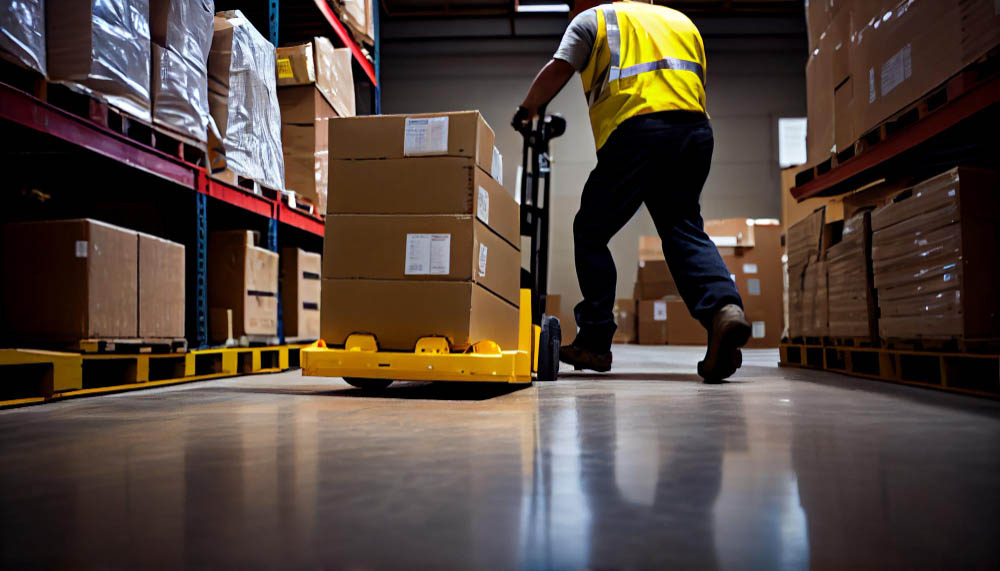
Lashing is the process of securing cargo with straps, chains, wire ropes, blocking, and locking equipment to reduce the risk of sliding, tipping, rolling, or shifting during transport. The primary goal is to ensure that the cargo stays in place throughout the journey and does not pose a risk to the vehicle, vessel, personnel, or the environment. Container lashing refers to performing this securing process inside a container or on the unit carrying the container, with proper distribution of forces.
What Does Lashing Do?
During transport, cargo doesn't simply sit still in a vehicle traveling in a straight line. Sudden braking, cornering, acceleration, rolling on a ship, and vibration all create longitudinal, lateral, and vertical forces on the cargo. Friction alone is rarely sufficient in most situations. This is where lashing comes in — it limits the uncontrolled movement of cargo forward, sideways, or upward. When container lashing is set up correctly, the risk of product damage, equipment strain, and workplace safety incidents decreases significantly.
What Is Lashing? Definition and Meaning
In the language of transport, the clearest answer to the question "what does lashing mean?" is securing and fastening. The fastening here should not be thought of as simply tying a rope. The aim is to establish a controlled securing arrangement that accounts for the cargo's weight, center of gravity, surface friction, and transport conditions. For this reason, the correct answer to "what is lashing?" is that it is a technical component of cargo safety.
What Should Be Considered When Lashing Cargo?

Correct lashing practice does not simply mean pulling a strap tight around the cargo. The type, weight, shape, center of gravity, contact surface, and mode of transport of the cargo are all evaluated together. The logic of securing cargo in short-distance road transport and maritime transport is built on the same foundation, but the force directions and frequency of checks may differ. Technical guidelines clearly state that cargo must remain in place under the anticipated accelerations. Another critical point is the direction of securing. In direct lashing, the direction of the lashing should be as close as possible to the direction of the movement being prevented. The longer the lashing, the more it stretches and the greater the cargo's room to move. A short, balanced arrangement fastened to appropriate points is therefore always more reliable. When planning container lashing, reducing gaps, using anti-slip materials, and selecting lashing components appropriate to their capacity are fundamental.
The main points to consider are as follows:
- Gaps should be closed with fillers where necessary.
- Cargo must be held against sliding and tipping through blocking, lashing, or a combination of both.
- Force should be distributed over a sufficiently wide area rather than concentrated at a single point.
- Where necessary, each individual piece of cargo should be secured independently.
- Anti-slip surface material should be used where appropriate.
- Hooks or appropriate connecting elements must be attached to the correct points.
- Securing equipment must not be applied so tightly as to strain the container or cargo structure.
- Tensioning elements must not be loaded beyond their rated capacity.
- Knots must not be tied in webbing straps.
- On long-distance or transshipment operations, lashings should be re-checked and re-tightened if necessary.
What Are Lashing Materials?
The type of transport and the nature of the cargo are the determining factors when selecting lashing materials. The most commonly used equipment includes synthetic webbing straps, chains, wire ropes, hooks, shackles, tensioning devices, turnbuckle-type tighteners, wire rope clamps, wedges, blocking pieces, and locking arrangements. Protective corner pieces that reduce abrasion on sharp-edged cargo are also important. In container lashing, the capacity of every component used is evaluated based on the weakest link in the lashing system — meaning a strong wire rope alone cannot compensate for a weak attachment point.
What Are the Types of Lashing?
The types of lashing fall under two main principles. The first is direct securing, where force is transferred directly from the cargo through the lashing equipment to the transport unit. The second is friction-based securing, where straps pressing down from above increase the cargo's grip on the floor. In practice, arrangements using top-over lashing, half-loop lashing, spring lashing, and in some cases a combination of blocking and lashing are employed. When preparing a container lashing plan, it is assessed whether the cargo is at risk of sliding, tipping, or both — and the method is chosen accordingly.
How Is Lashing Done? Step-by-Step Guide
The weight, center of gravity, surface characteristics, and direction of transport are determined first. Appropriate transport units and securing points are then selected. Cargo is loaded as tightly as possible, remaining gaps are closed, and either direct securing or friction-based methods are preferred depending on the direction of risk. Lashings are kept short, tension is applied evenly on both sides, and protection is used at sharp corners. Knots are not tied in webbing straps, and over-tightening is avoided. Re-checking after the first movement and at transshipment points is a good practice.
Legal Regulations on Cargo Lashing
Rules regarding lashing vary by mode of transport. In maritime and intermodal transport, international cargo securing codes clearly stipulate that cargo must be properly stowed, appropriate equipment must be used, and personnel performing the work must be trained. In European road inspections, cargo securing is a separate inspection category. Inspectors examine the condition and number of securing points, the forces they bear, the methods used, and whether the cargo would remain in place during emergency maneuvers. In cases where serious deficiencies are found in container lashing, restrictions on the vehicle's use are also possible.
For Which Types of Cargo Is Lashing Most Critical?
Lashing becomes far more critical for cargo with a high center of gravity, a risk of tipping, contact with a slippery surface, or an irregular shape. Machinery and equipment, rolls, unpalletized metal parts, large wooden crates, pipes, and heavy industrial products require more careful securing during transport. When preparing a container lashing plan, it should also be checked whether the cargo leaves any gaps — because even a small amount of play can turn into serious damage on the road. In long-distance shipments, maritime transport, and transshipment operations, correct lashing practice is of great importance not only for cargo safety but also for the safety of personnel.