

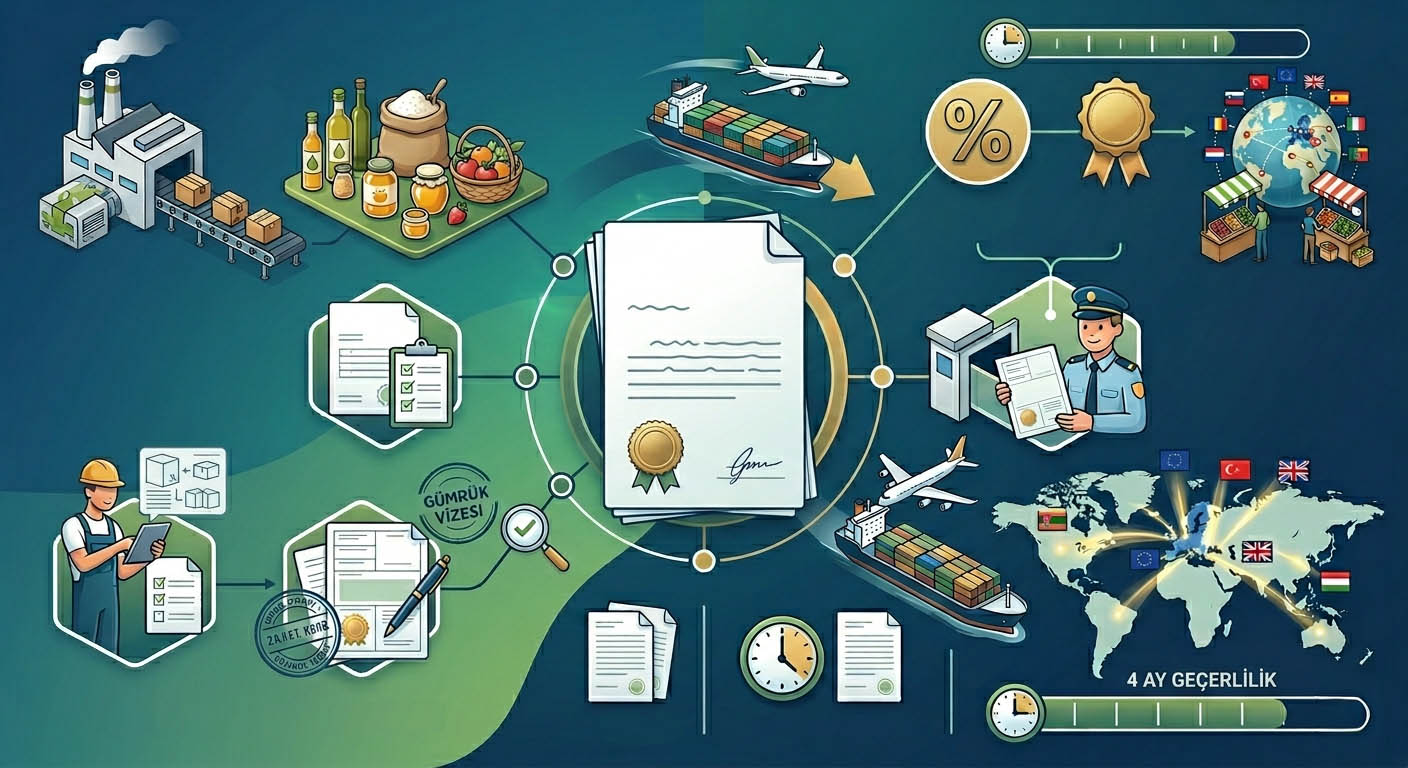
The EUR.1 certificate is a movement certificate that indicates the preferential origin status of goods and can provide customs duty advantages in exports. In the clearest terms, it shows that the goods are considered originating according to the rules of the relevant agreement. It is one of the primary documents used to apply reduced or zero customs duties in the importing country. The EUR.1 Movement Certificate serves as a document used to prove the origin of the goods.
For exporting businesses, the certification process is not merely about filling out paperwork. The product's origin, invoice information, mode of transport, destination country, and the relevant trade agreement are evaluated together. For companies exporting organic food, local products, olives, honey, flour, legumes, or dairy products, origin information strengthens commercial trust. In brands like Datça Murat Çiftliği, which focus on organic certification and domestic production, the clear explanation of the product's source is a valuable example for the correct structuring of export documents.
How is the EUR.1 Certificate Issued?
The first step in issuing an EUR.1 certificate is checking whether the product complies with the preferential origin rules. Not every exported product is automatically covered by the certificate. The production site of the goods, the inputs used, the labor process, and the effective agreement with the relevant country are taken into account.
The following steps are generally followed during the issuance process:
- The exporter prepares the commercial invoice and product information.
- Documents showing the origin status of the goods are checked.
- The certificate form is filled out completely.
- Approval is obtained from the Chamber of Commerce.
- The customs administration vises (validates) the document.
- The document is sent to the importer and presented at the import customs.
In EUR.1 certificate applications, the product description must be consistent with the invoice information. If there is a discrepancy between the product name, brand, number of packages, gross weight, transport mode, and destination country, the transaction may be delayed. For food products, organic certificates, analysis reports, manufacturer declarations, or procurement documents can also be among the papers that strengthen the process.
Filling Out the EUR.1 Movement Certificate
Each box of the document must be filled out carefully. Even small typographical errors can lead to additional inspections during customs procedures.
- Box 1: Enter the registered title, full address, and country of the exporting company. Company information must match the trade registry and the invoice.
- Box 2: Shows the preferential trade between which countries or parties the certificate will be used. The relevant agreement relationship should be stated correctly.
- Box 3: Add the registered title, full address, and country of the importing company. If the recipient company and the shipping address are different, the explanation should be made carefully.
- Box 4: Reserved for the country considered the origin of the products. Origin information must be clear; speculative expressions should not be used.
- Box 5: Contains the destination country. The country where the shipment will actually go is taken into account.
- Box 6: For transport information. The type of transport, such as Truck, Plane, Ship, or Train, is written.
- Box 7: Filled out by the approving authority. The seal, signature, and date section are completed by the authorized unit.
- Box 8: Contains the item number, name, brand, type, package information, and description of the goods subject to export. Since origin information is in Box 4, expressions re-stating the origin of the goods are not used in the product description section.
- Box 9: Enter the gross weight.
- Box 10: For invoice information. Invoice number and date can be added.
- Box 11: The visa area for the customs administration.
- Box 12: Contains the exporter's stamp, authorized signature, and date of issue.
Documents Required for Approval of the EUR.1 Movement Certificate
The file must be prepared completely for EUR.1 certificate approval. In the general application structure, a letter of undertaking, the Turkish commercial invoice belonging to the exporter, and supporting documents showing the origin of the product are required.
It is important that the commercial invoice is approved or prepared in accordance with the procedure. For products not of Turkish origin, a copy of the customs entry declaration showing the origin of the goods may be requested. For inputs of European Union origin, Pan-Euro-Mediterranean Cumulation rules may be taken into account.
Since the EUR.1 Movement Certificate indicates origin status, it is not considered appropriate in all cases to approve it together with a Certificate of Origin for the same transaction. Even if there is a Letter of Credit (L/C) requirement, the distinction between document types should not be overlooked.
Duplicate EUR.1 Movement Certificate
In the event that the originally issued certificate is stolen, lost, or destroyed, a duplicate may be issued. This process does not create a new right of origin; it serves as a registered copy replacing the first document.
The application file generally includes a duplicate petition, a copy of the first issued document, a copy of the customs export declaration, and the export invoice. When issuing a duplicate, a "Duplicate" entry is made in the observations field. The date and serial number of the original certificate are also added to the document.
A new date or a different serial number is not given in the customs visa section. The visa information of the first document is taken as the basis. A document registered as a duplicate is valid from the original date of issue and must be submitted to the importing customs administration within 4 months from the date of visa by the exporter's customs administration.
EUR.1 Movement Certificate Issued Retrospectively
If a certificate was not issued at the time of export due to oversight, neglect, error, or special circumstances, it can be obtained after the export of the goods. In such a case, the application is examined more carefully because the goods have already departed. For the application, a letter of undertaking, invoice, origin support documents, and standard issuance papers are prepared. For products whose customs exit is completed, the consistency of date, declaration, and invoice must be clearly seen. The "Issued Retrospectively" entry is made in the observations section of the document. The healthiest way for the exporter is to check the document requirement before shipment. Nevertheless, missing documents, operational intensity, or transport plan changes can occasionally occur in trade. Retrospective issuance is a practical way to reduce the loss of rights with the correct document.
Points to Consider and Valid Countries for EUR.1 Movement Certificates
The EUR.1 certificate should not be seen as limited only to the exporter's declaration. When necessary, production records, supplier declarations, origin documents of raw materials used, internal accounting records, invoice declarations, and previous movement certificates may be requested.
If the destination country and the country where trade is conducted are different, the recipient information must be written clearly. The company to which the shipment will be made, the country, and the party on whose behalf the transaction is conducted must be explicitly stated. The document must be presented to the importing customs within 4 months from the date it was vised by the exporting country's customs administration. The time calculation is also carefully monitored for duplicates and retrospectively issued documents.
The EUR.1 Movement Certificate can be used in trade of ECSC (European Coal and Steel Community) products and agricultural products with the European Union. Current EU member states include Germany, Austria, Belgium, Bulgaria, Czechia, Denmark, Estonia, Finland, France, GCN (Greek Cypriot Administration), Croatia, Netherlands, Ireland, Spain, Sweden, Italy, Latvia, Lithuania, Luxembourg, Hungary, Malta, Poland, Portugal, Romania, Slovakia, Slovenia, and Greece. The United Kingdom is not a current member of the EU.
Within the scope of Turkey's effective free trade agreements, preferential origin rules may come into play in trade with countries such as EFTA, Macedonia, Bosnia and Herzegovina, Palestine, Tunisia, Morocco, Egypt, Albania, Georgia, Montenegro, Serbia, Chile, Mauritius, South Korea, Malaysia, Moldova, Faroe Islands, Singapore, Kosovo, Venezuela, United Kingdom, United Arab Emirates, and Qatar. Since the document type and application may change depending on the relevant agreement, a check should be performed on the basis of country, product, and HS Code (GTİP) before the transaction.