
EXW is an international trade term in which the seller makes the goods available for the buyer at their own premises, such as a warehouse, factory, or another agreed location. Under this rule, the seller’s responsibility is quite limited. The seller prepares the product, packages it, and keeps it ready at a point where the buyer can collect it. Transportation, loading, export procedures, insurance, customs, and the import process are largely managed by the buyer. The Ex Works delivery term represents one of the lowest levels of responsibility for the seller. The buyer, on the other hand, undertakes almost the entire operation from the seller’s premises to the final destination.
How Does Ex Works Delivery Work?
In EXW practice, the parties first clearly define the place of delivery. This can be a factory, warehouse, production facility, bonded warehouse, or the seller’s place of business. The seller prepares the goods in accordance with the contract and makes them available to the buyer on the agreed date. The buyer organizes the vehicle, plans the loading, arranges the carrier, and manages the entire process from the point of origin to the destination. Under the Ex Works delivery term, the risk transfers to the buyer as soon as the goods are placed at the buyer’s disposal. The seller is not obligated to load the goods onto the vehicle. If the parties agree otherwise regarding loading, it must be clearly stated in the contract. Otherwise, damage or delays during loading may lead to disputes. When choosing EXW, details such as delivery address, loading time, vehicle information, packaging details, and document flow should be clarified in advance.
Responsibilities of Buyer and Seller Under Ex Works
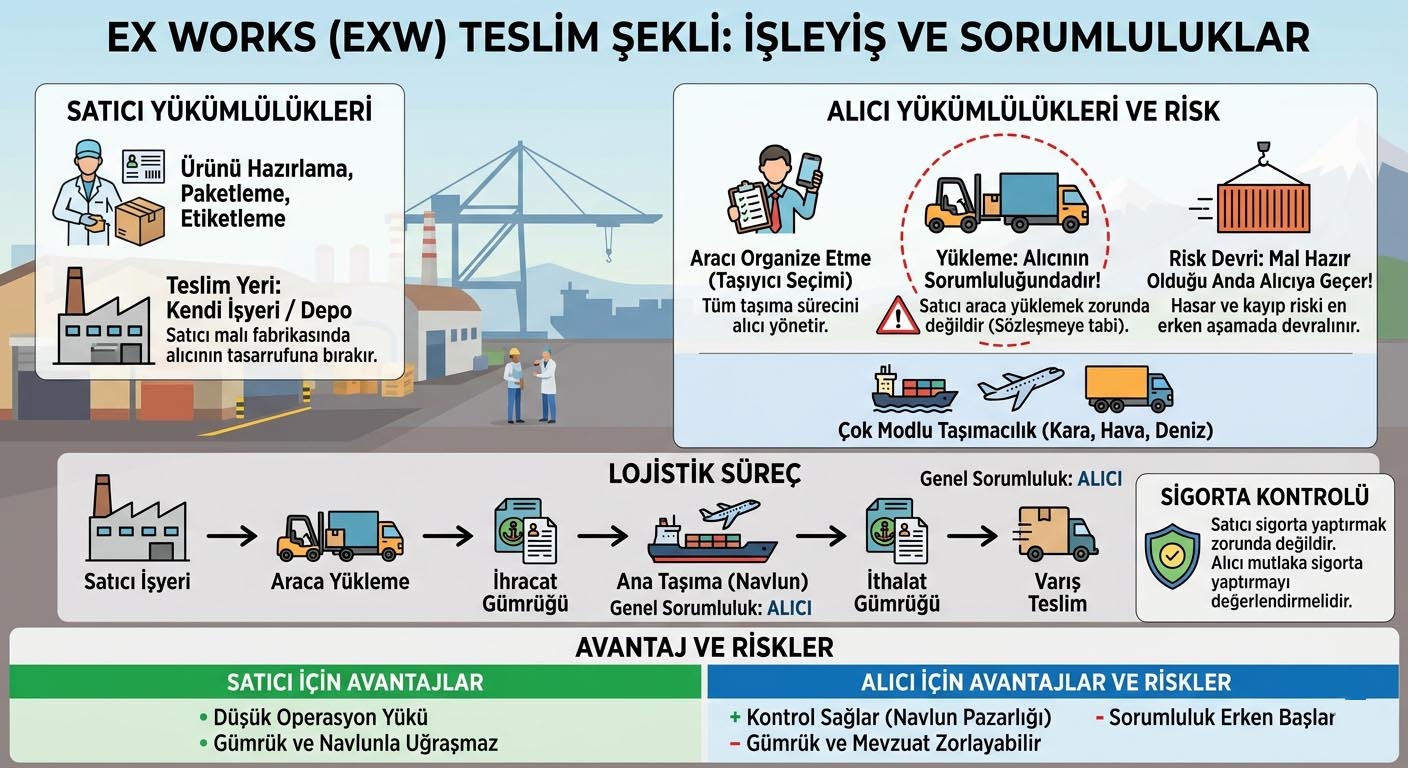
Under the Ex Works structure, the distribution of responsibilities is quite clear. The seller is responsible for preparing the goods in accordance with the sales contract. The goods are packaged, labeled, and made ready for pickup at the specified location. The seller has no obligation to organize transportation, load the goods, handle export customs, or pay freight charges. The buyer, however, bears broader responsibilities. Transportation arrangements, loading, export documentation, export customs clearance, main carriage, insurance, import procedures, taxes, and final delivery are all within the buyer’s scope. If the buyer lacks experience under EXW, the process may become challenging. Businesses without sufficient logistics, customs, or documentation knowledge may face delays due to incorrect carrier selection or missing documents.
Buyer
The buyer has the most extensive responsibilities under EXW. Once the goods are ready at the seller’s premises, the buyer arranges a vehicle for pickup, organizes loading, and assumes all transportation risks. Export and import customs procedures also fall under the buyer’s responsibility. If the goods are sourced from another country, the buyer must have the knowledge and representation capability to handle official procedures in the country of export. Insurance is particularly important for the buyer. The seller is not required to obtain insurance. Since the risk transfers to the buyer as soon as the goods are made available at the seller’s premises, any damage or loss during transportation may result in costs for the buyer. The buyer must send the vehicle on time, select the correct transport equipment, and inspect the goods for damage upon collection. EXW provides control to the buyer but requires careful planning.
Seller
The seller prepares the goods in accordance with the quality, quantity, and packaging conditions specified in the contract. The goods are made available to the buyer at the agreed place of delivery. The seller provides the invoice, product information, and essential documents. The seller’s main obligation is to make the goods available for collection. Arranging transportation, providing a vehicle, assuming loading risk, or handling customs procedures is generally not the seller’s responsibility. For the seller, EXW offers a simple structure with minimal operational burden. However, the seller should clearly communicate the delivery time, product readiness, and packaging details. Reasonable support may be provided for export documentation requested by the buyer. If the seller is to participate in loading, the limits of risk and responsibility should be clearly defined in the contract. Unclear loading assistance may lead to disputes over damage.
Advantages of Ex Works Delivery
The Ex Works delivery term is practical and involves a low operational burden for the seller. The seller does not need to establish a transportation network or deal with customs regulations in different countries. The goods are made ready at the seller’s premises, and the main responsibility at the delivery point is fulfilled. It provides a simple structure for small-scale exporters or companies that prefer to leave transportation organization to the buyer. For the buyer, the advantage lies in having full control over the logistics process. The buyer selects the carrier, negotiates freight rates, arranges insurance policies according to their needs, and manages the delivery chain end-to-end. For companies that import regularly, this can provide cost control. The strength of EXW becomes evident when the buyer has strong logistics experience. If the buyer manages the transportation network effectively, the process becomes more predictable.
Risks of Ex Works Delivery
Using Ex Works may be challenging for the buyer in some cases. The main risk is that responsibility transfers to the buyer at a very early stage. Once the goods are ready at the seller’s premises, the buyer assumes all transportation risks. Damage during loading, incorrect vehicle selection, missing documents, customs delays, and uninsured transport may lead to significant costs for the buyer. Managing export procedures in the seller’s country is not always easy for the buyer. In some countries, export declarations, local registrations, and documentation may require information from the seller. In such cases, the parties may consider choosing a more suitable delivery term. EXW may appear simple but requires a carefully drafted contract in international shipments. The place of delivery, loading responsibility, document support, and insurance decisions should be clearly defined in writing.
Where Is Ex Works Used?
Ex Works can be used in road, air, sea, rail, and multimodal transport. However, it is most convenient when the buyer has a strong logistics network in the seller’s country. It provides a simpler structure in domestic trade or in operations where the buyer fully controls the transportation process. In international trade, if the buyer lacks sufficient customs or logistics knowledge, other delivery terms may be safer. For example, if the seller is expected to handle export procedures, rules such as FCA may be considered. If EXW is to be used, details such as the location where the goods will be made available, delivery date, packaging standards, loading equipment, carrier information, and insurance plan must be clearly defined. When planned correctly, EXW creates a simple structure for the seller and a control-oriented process for the buyer.