


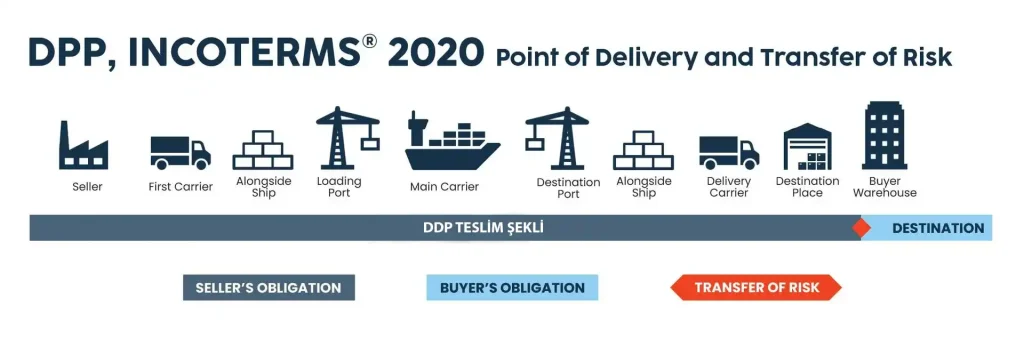
DDP delivery term is the delivery rule in international trade under which the seller undertakes to bring the goods to the designated address in the buyer's country, complete the import customs procedures, and pay the taxes and duties. It is one of the easiest delivery structures from the buyer's perspective, because the product becomes ready to be received at the designated point. The seller, on the other hand, manages the risks arising during transportation, export, transit, import customs, taxes and up to the place of destination. The delivery is completed when the goods are made available to the buyer at the destination, ready for unloading.
Changes Made to the DDP Incoterms Delivery Term
Within the Incoterms 2020 rules, the DDP delivery term retains its place as the delivery rule that grants the broadest responsibility to the seller. The basic logic has not changed. The seller brings the product to the agreed address in the buyer's country and bears the costs, including import taxes. The buyer receives the product at the place of delivery. The transfer of risk also takes place at the destination, when the product is placed at the buyer's disposal. The point to be considered here is that the seller must be in a position to carry out the import procedures in the buyer's country. In some countries, a foreign seller may need to have an importer registration, a tax number, or use a representative. If a sales contract is concluded before these conditions are clarified, the transaction may become difficult in the field. The DDP rule provides a strong customer experience, but requires serious preparation on the customs and tax side for the seller.
How Does the DDP Delivery Term Work?
The DDP delivery term process operates by the seller planning the product from the point of departure to the delivery address determined by the buyer. The seller prepares the goods, packages them, handles the export procedures, sets up the transportation organization, follows up on the transit passages, completes the import customs and pays the taxes. The buyer side, on the other hand, receives the product at the designated point.
- The seller prepares the product, transportation, customs and delivery plan.
- The product departs from the country of origin after the export procedures are completed.
- In the destination country, import customs, taxes and official procedures are carried out by the seller.
- The product is brought to the designated address and made ready for the buyer to receive.
In DDP application, who is responsible for the unloading process must be clearly stated in the contract. Delivery takes place on the arriving vehicle and in a state ready for unloading. If the parties wish to leave the unloading to the seller, this must be specified separately.
What Are the Seller's Responsibilities Under DDP Delivery?
The seller's responsibilities under DDP delivery are quite extensive. The seller manages almost the entire commercial and logistics process to ensure the product reaches the address in the buyer's country. Planning, cost calculation and knowledge of local legislation are very important from the seller's perspective.
- Prepares the product in accordance with the sales contract.
- Handles packaging and labeling operations.
- Completes the export customs procedures.
- Organizes the main transportation and intermediate transportation processes.
- Carries out the necessary procedures during transit passages.
- Follows up on the import customs process in the destination country.
The seller also undertakes the taxes and official payments related to the import. The DDP delivery term makes accurate cost calculation a necessity for the seller. The tax rate, product code, transportation route and local practices must be checked from the outset.
What Are the Buyer's Responsibilities Under DDP Delivery?
The buyer's responsibilities under DDP delivery are more limited. The process proceeds more comfortably for the buyer because the seller brings the product to the place of delivery with the taxes paid. Nevertheless, the buyer must be careful regarding the correct provision of the delivery address and the timely receipt of the product.
- Provides the delivery address correctly and completely.
- Pays the sales price in accordance with the contract.
- Makes the necessary acceptance preparations for the delivery day.
- Receives the product at the specified point.
- If unloading is their own responsibility, plans the equipment and personnel.
- Checks for damage or missing products during delivery.
The most important duty of the buyer is to provide accurate information. An incorrect address, incomplete delivery point or closed warehouse hours can cause delivery delays. DDP provides a comfortable structure for the buyer, but the practical preparation on the receiving side still rests with the buyer.
What Are the Features of the DDP Delivery Term?
The DDP delivery term has a structure that provides convenience to the buyer and imposes a high operational burden on the seller. The place of delivery is determined in the destination country. The seller brings the goods to that point. Tax and customs procedures are also carried out by the seller.
It is one of the delivery terms in which the seller's responsibility is at its broadest.
- The transactional burden on the buyer is quite low.
- Import customs clearance is handled by the seller.
- Taxes, duties and official payments belong to the seller.
- The place of delivery is clearly specified in the contract.
- The risk is transferred when the product is ready for the buyer at the designated address.
- Insurance is not mandatory, but the seller should consider it because they bear the risk.
- The unloading responsibility must be clearly stated in the contract.
- It is frequently used in e-commerce and door-to-door deliveries.
- The seller must have a good knowledge of the legislation in the destination country.
How Is DDP Calculated?
When making a DDP calculation, looking at the product price alone is not sufficient. The seller must take into account all the expenses that will arise up to the delivery address in the buyer's country. A sample calculation can be set up as follows:
Suppose the product price is 8,000 dollars. If the packaging and loading expense is 300 dollars, inland transportation is 250 dollars, the export customs expense is 200 dollars, international freight is 1,100 dollars, the import customs service in the destination country is 350 dollars, the total of taxes and duties is 1,600 dollars, and final delivery is 400 dollars, the total DDP cost amounts to 12,200 dollars.
The DDP price is calculated with the following logic:
Cost of Goods + Packaging + Departure Transportation + Export Procedures + Main Freight + Transit Costs + Import Customs + Taxes + Inland Transportation at Destination + Operation Expense
For the DDP delivery term, a sound price cannot be given without clarifying the product HS code, tax rate, route, mode of transportation and delivery address. An incorrect tax calculation or missing local expense can cause the seller to suffer unexpected losses.
Why Is the DDP Term Used?
The DDP term is used to give the buyer a simple and clear delivery experience. It is an effective option when the buyer does not want to deal with import procedures or when the seller wants to make door-to-door sales. It can be preferred in e-commerce, sample shipments, retail exports, dealer deliveries and direct sales to the end user.
The advantage from the seller's perspective is that it keeps the customer experience under control. The buyer knows more clearly when the product will arrive and whether they will face additional taxes during delivery. The disadvantage is that the seller assumes the burden of customs, tax and official procedures in the destination country.
If the DDP delivery term is to be selected, the seller must definitely check the product code, tax rates, import permits, the need for a local representative and the delivery address. This model, which is one of the most comfortable structures for the buyer, can turn into a strong commercial advantage for the seller when carefully planned.